Selecting the right commercial pump system in Hudson is one of the more consequential decisions a property owner or manager will make. Get it right and you have reliable, consistent water pressure for years. Get it wrong and you’re looking at premature equipment failure, inadequate flow, and disruptions that affect tenants, irrigation schedules, or daily operations. This guide walks through the key variables that should drive your decision — before you ever purchase a piece of equipment.
Why Hudson Properties Have Unique Pump Demands
Hudson sits in western Pasco County, where the Floridan Aquifer System drives nearly all private well water supply. This aquifer runs deep through porous limestone formations, which creates both opportunities and challenges. Water is generally abundant, but the geology can introduce dissolved minerals, hydrogen sulfide (sulfur odor), and in some cases fine sediment that affects pump longevity.
The proximity to the Gulf Coast also means Hudson properties are in the path of major storm systems. Hurricane-season power surges and extended outages put real stress on pump motors and control panels. Any commercial pump selection here should account for surge protection and, where critical operations are involved, backup power compatibility.
Start with Flow Rate and Pressure Demands
Before evaluating any pump model or configuration, you need a clear picture of your water demand. For commercial properties — whether that’s a business park, HOA common areas, agricultural operation, or multi-unit development — flow rate is the foundational spec. It’s measured in gallons per minute (GPM) and needs to reflect peak demand, not just average usage.
How to Estimate Flow Requirements
Add up all the draw points that could run simultaneously: irrigation zones, restrooms, fire suppression headers, cooling systems, or processing equipment. A licensed contractor will run these calculations based on actual fixture counts and operational schedules. Undersizing a pump for a commercial application creates chronic low-pressure complaints and shortened motor life. Oversizing wastes energy and causes rapid cycling that damages pump components.
A professional commercial pump system assessment in Hudson should always include a well yield test alongside a demand analysis. Matching pump output to well yield prevents drawdown problems and protects the aquifer formation around the casing.
Aquifer Depth and Pump Selection
In Pasco County commercial well applications, pump depth varies considerably. Shallower wells tapping the surficial aquifer are common for irrigation-only uses, but most commercial domestic or mixed-use wells reach into the Floridan Aquifer, often at depths between 100 and 400+ feet depending on the parcel location and intended use.
Submersible pumps are the standard for these depths. The motor and pump assembly sit below the water line, which keeps the motor cool and reduces surface-level noise. For shallower commercial applications — irrigation header tanks, for example — above-ground centrifugal or jet pump configurations may be appropriate, though they require more maintenance access planning.
Grundfos Commercial Pumps: What Sets Them Apart
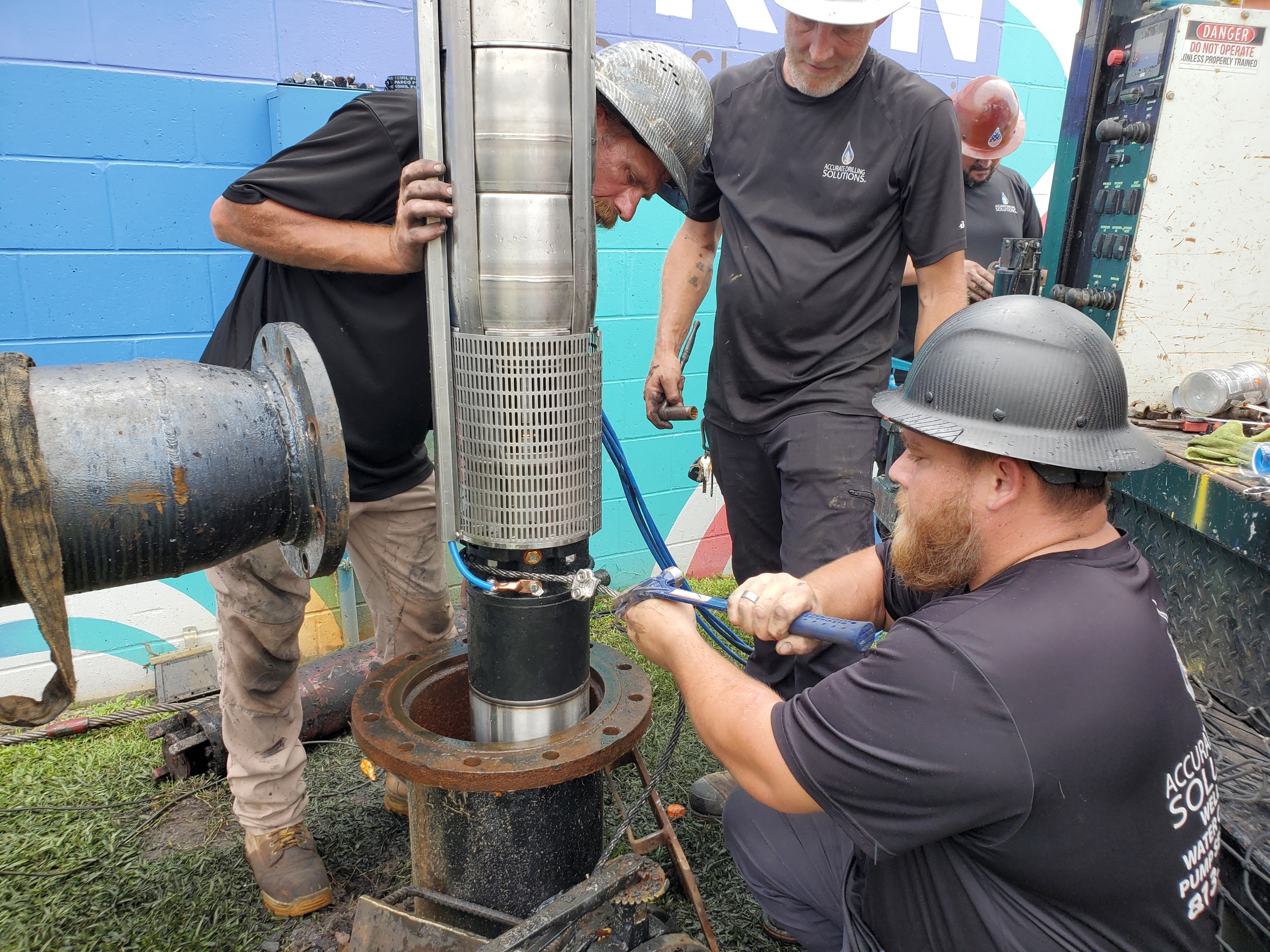
When evaluating submersible pump brands for a Pasco County commercial well, the engineering behind the equipment matters. Grundfos is widely recognized in the water industry for precision motor tolerances, corrosion-resistant materials, and intelligent motor protection features. As a premier dealer of Grundfos commercial pumps, Accurate Drilling Solutions installs these systems across the region because the performance data in Florida’s mineral-heavy water environments consistently holds up.
Grundfos submersible motors include built-in thermal and overload protection, which is especially valuable in applications where the pump runs on long cycles or where power fluctuations are common during storm season. Their variable-speed models also allow pressure to be maintained consistently without the energy draw of fixed-speed systems running at full capacity continuously.
Single-Pump vs. Multi-Pump System Configurations
Smaller commercial properties with moderate, predictable water demand are often well served by a single high-capacity submersible pump paired with a correctly sized pressure tank. This keeps the system straightforward to maintain and troubleshoot.
Larger properties — CDDs, HOA communities with shared irrigation, industrial facilities, or multi-building campuses — frequently benefit from a multi-pump system in Florida’s commercial well applications. There are two primary approaches:
Parallel Pump Configurations
Multiple pumps installed to draw from the same well or wellfield and run simultaneously to meet high-flow demands. This is effective when peak demand spikes exceed what a single pump can deliver. Parallel setups also provide redundancy — if one pump requires service, the others continue to run.
Duty/Standby Configurations
One pump handles normal operations while a second pump sits on standby, automatically activating when the primary fails or during peak demand. This is common in applications where water interruption is not acceptable — certain commercial kitchens, fire suppression systems, or facilities serving vulnerable populations.
The right configuration depends on your demand profile, acceptable downtime tolerance, and well capacity. This is not a decision to make based on equipment specs alone — it requires a site evaluation by a licensed contractor who has reviewed the well log, yield test results, and your operational requirements.
When to Call a Licensed Contractor vs. Handling It In-House
Some commercial property managers handle minor maintenance tasks in-house: inspecting pressure gauges, checking for visible leaks at the wellhead, or testing pressure switch settings. These tasks are appropriate for trained maintenance staff.
Everything else — pump replacement, well deepening, control panel work, adding a booster pump, or diagnosing significant pressure loss — requires a licensed well contractor in Florida. State law requires licensing for a reason: improper work on a commercial well can contaminate the water supply, void pump warranties, and create liability exposure for the property owner.
If your property is showing signs of declining pressure, increased pump cycling, or sediment in the water supply, those are triggers for a professional evaluation. Water pump repair and diagnostics from a qualified contractor will identify whether the issue is mechanical, hydraulic, or related to changes in the aquifer itself.
Maintenance Agreements for Commercial Systems
Commercial pump systems run harder and more continuously than residential systems. Scheduled maintenance — including pump performance testing, electrical connections, pressure tank inspection, and water quality checks — extends system life and catches problems before they become emergencies.
Many HOAs and CDDs managing shared well infrastructure in Hudson and throughout Pasco County work with Accurate Drilling Solutions through structured maintenance agreements that provide scheduled service visits and priority response. For properties where water service interruption has real operational or liability consequences, a maintenance agreement is a straightforward way to reduce that risk.
Hudson Florida Well Pump Upgrades: Timing Matters
The best time to evaluate a Hudson Florida well pump upgrade is before the current system fails. Reactive replacement — particularly during the summer irrigation season or after a major storm — often means working under time pressure with limited equipment options. Planning an upgrade during late fall or early spring gives contractors scheduling flexibility and allows time for proper well yield testing, equipment procurement, and permitting if required.
If your commercial system is more than 10-15 years old and hasn’t been inspected recently, a video well inspection is a practical starting point. It reveals the condition of the casing, screens, and pump column without pulling the equipment — so you can make an upgrade decision with actual data rather than guesswork.
Choosing the Right Partner for Your Commercial Pump Project
Not every contractor has experience with the specific demands of Pasco County commercial well systems. The limestone aquifer geology, the regulatory environment, the equipment demands of multi-unit properties — these require a contractor who has worked extensively in the region. The team at Accurate Drilling Solutions brings that regional experience alongside a full inventory of commercial-grade equipment, including Grundfos pump systems, to commercial well projects throughout Hudson and the surrounding area.
When evaluating your options for a commercial water pump selection, ask contractors about their experience with your specific well depth range, their familiarity with Pasco County permitting requirements, and the brands they stock and service. The answers will tell you quickly whether you’re talking to someone who can genuinely support your project.
Frequently Asked Questions
What flow rate does a typical commercial property in Hudson need?
It varies widely depending on property type and use. A small commercial building might need 20-40 GPM, while a CDD with shared irrigation across multiple zones could require 100 GPM or more at peak demand. A licensed contractor will calculate this based on your fixture count, irrigation zone layout, and operational schedule — not a generic rule of thumb.
How deep are commercial wells typically drilled in Pasco County?
Most commercial wells in Pasco County targeting the Floridan Aquifer range from roughly 100 to 400+ feet, depending on local geology and intended use. A well driller familiar with western Pasco County hydrogeology will review local well logs and aquifer data before recommending a target depth for your specific parcel.
What are the signs that a commercial pump system needs to be replaced rather than repaired?
Recurring motor failures, significant drops in yield that can’t be resolved by pump adjustment, casing corrosion identified through video inspection, and systems that no longer meet your current demand requirements are all indicators that replacement is the more practical path. A professional evaluation will help you weigh repair versus replacement based on the actual condition of your equipment.
Is a multi-pump system always better for large commercial properties?
Not necessarily. Multi-pump systems add redundancy and can meet higher peak demands, but they also add complexity and maintenance requirements. For some large properties, a single high-capacity pump with a properly sized storage tank and pressure system is more cost-effective and easier to maintain. The right answer depends on your demand profile and acceptable downtime tolerance.
Do commercial well pump installations in Florida require permits?
Yes. Commercial well work in Florida typically requires permits through the applicable Water Management District — in Hudson’s case, the Southwest Florida Water Management District (SWFWMD). A licensed contractor handles the permitting process, but property owners should be aware that unpermitted work creates compliance and liability exposure.
How does sulfur water in Hudson affect commercial pump selection?
Hydrogen sulfide present in some Pasco County aquifer water can accelerate corrosion on pump components, particularly on motors and casings with lower-grade stainless or carbon steel parts. Specifying pumps with stainless steel construction and compatible seals — as found in quality Grundfos commercial models — helps manage this. A water quality test before pump selection is a worthwhile step for any commercial well project in the area.
Ready to evaluate your options for a commercial pump system in Hudson? Call Accurate Drilling Solutions at 813-643-6161 to speak with a licensed contractor who knows Pasco County commercial well systems from the ground up.
continue reading
Related Posts
If your geothermal system in Largo is showing signs of reduced performance, the supply well may be the source of the problem. This article covers the key symptoms of well yield decline, limestone aquifer scaling, and reduced system efficiency — and what to do about them.
Selecting the right well pump system in Zephyrhills involves more than picking a pump off a shelf. This guide walks Pasco County property owners through submersible vs. jet pump comparisons, Florida-specific sizing factors, and why professional installation is the only responsible path forward.

Largo's coastal position, shallow Floridan Aquifer access, and aging residential well infrastructure create specific stress patterns on well pump systems. Understanding these local conditions helps homeowners protect their equipment before problems develop. Learn what makes Largo different — and what to do about it.